


Views: 0 Author: Site Editor Publish Time: 2026-08-14 Origin: Site


You are under the car, staring at a sputtering exhaust leak. Your eyes dart to the nearest tube of red or copper sealant on the garage shelf. It is a common scenario for anyone wrenching on their own vehicle. The immediate temptation is to smear whatever chemical is available over the gap, tighten the clamp, and hope the noise stops. Exhaust systems operate under extreme thermal stress, corrosive gases, and constant physical vibration. Applying the wrong chemical sealant results in immediate failure, toxic off-gassing, and potential damage to downstream emissions components. Matching the sealant's chemical composition to the specific exhaust zone is a technical necessity. A standard engine sealant will not survive the environment of a catalytic converter or an exhaust manifold. To achieve a functional, safe seal, you must understand the critical differences between elastomeric high-temperature RTV silicone and ceramic-based exhaust repair paste.
Thermal Mismatch: High-temperature RTV silicone typically fails above 650°F (343°C), making it unsuitable for direct exhaust flow repairs where temperatures easily exceed 1,000°F (537°C).
Chemical Superiority for Heat: Exhaust repair paste utilizes sodium silicate and ceramic binders to withstand temperatures up to 2,000°F (1,093°C), hardening into a rigid seal under exhaust heat.
Application Specificity: RTV silicone is designed for flexible, low-pressure engine sealing (oil pans, valve covers), whereas exhaust paste is engineered specifically for high-pressure, high-heat exhaust joints and pinhole leaks.
Temporary vs. Permanent: Both chemical solutions are temporary mitigation strategies; permanent fixes require mechanical replacement or professional welding.
To understand why certain sealants fail, you first have to look at the extreme environment they endure. An exhaust system is not a uniform pipe. It is a series of distinct thermal zones. Each zone presents different challenges to chemical compounds. You cannot treat a tailpipe leak the same way you treat a cracked manifold. The heat variance dictates the repair method.
Mechanics know that heat destroys weak materials. We can break down the exhaust system into four main thermal zones. Each requires a specific approach to sealing.
Exhaust Zone | Average Operating Temperature | Thermal Characteristics |
|---|---|---|
Exhaust Manifold/Headers | 900°F to 1,200°F+ | Direct combustion exit. Highest thermal shock. Extreme pressure spikes. |
Catalytic Converter | 1,200°F to 1,600°F | Exothermic chemical reactions generate massive localized heat. |
Resonator/Muffler | 300°F to 600°F | Cooling occurs as gases expand and travel rearward. |
Tailpipe | 200°F to 400°F | Lowest heat zone. High moisture accumulation from condensation. |
Heat is only one part of the equation. Exhaust systems endure continuous pulsation. Exhaust valves open and close thousands of times per minute. This creates rapid pressure spikes. These spikes try to blow out any weak points in a joint. Simultaneously, the physical vibration of the chassis and engine block tests the tensile strength of the sealant. The entire system flexes as the vehicle moves over uneven terrain. Engine mounts allow the block to torque under acceleration. This movement transfers directly down the exhaust pipe. If a sealant cannot handle this mechanical stress, it will crack and fall out.
For a chemical sealant to survive this environment, it must meet strict criteria. It must resist blowout under heavy acceleration when backpressure peaks. It must survive rapid heating and cooling cycles. Metal expands when hot and shrinks when cold. The sealant must accommodate this without losing its grip. Finally, it must maintain strong adhesion to steel. Exhaust pipes are rarely clean. They are often oxidized, pitted, or covered in carbon deposits. The sealant needs to bite into that imperfect surface.
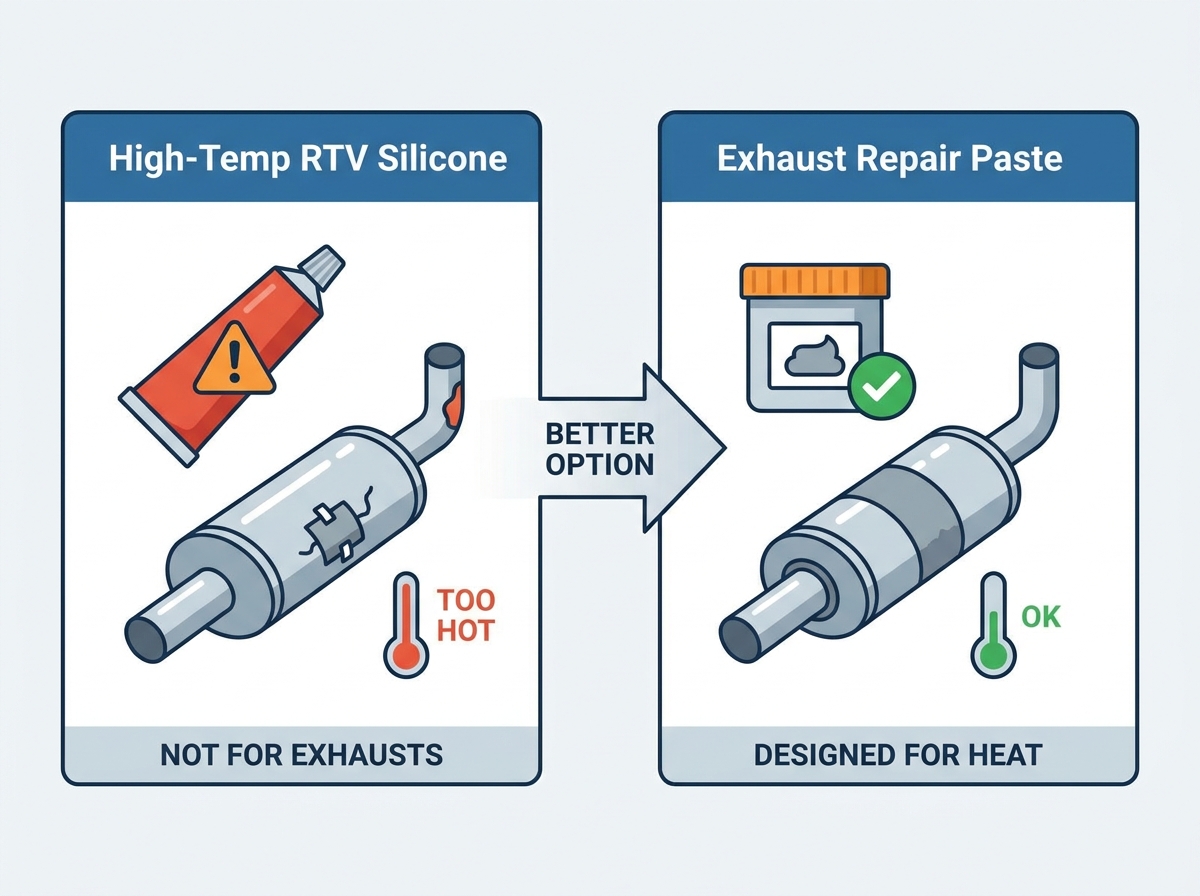
Room Temperature Vulcanizing (RTV) silicone is a staple in automotive repair. However, its application parameters are frequently misunderstood. It is an elastomeric material. It cures into a flexible, rubber-like state. This makes it excellent at absorbing vibration and sealing irregular flanges on engine blocks. It is not designed for exhaust gas exposure.
High-temp silicones are often infused with copper or other additives. These additives improve heat transfer and thermal stability. The curing chemistry matters immensely. Acid-curing (acetoxy) silicones release acetic acid as they dry. This smells like vinegar. It actively corrodes bare metal. For automotive applications, technicians rely on sensor-safe neutral-cure silicones. These formulations do not release corrosive byproducts. They are safe to use around sensitive electronic components like sensors.
Despite the high-temp label, RTV has hard chemical limits. Most premium high-temperature RTV silicone products are rated for continuous exposure up to 500°F. They can handle intermittent spikes up to 650°F. Once temperatures exceed this threshold, the molecular structure of the silicone breaks down rapidly. It cannot survive the 1,000°F+ environment of an exhaust manifold.
A common mistake is assuming RTV can replace any gasket on a vehicle. RTV silicone cannot survive combustion pressure. You must never use it as a standalone replacement for a head gasket or a main exhaust manifold gasket. The pressure will simply blow the silicone out of the gap. This is entirely different from high-temperature copper gasket spray adhesives. Those are thin liquids used solely to tack pre-cut metal gaskets in place. They improve micro-sealing. They do not act as a structural barrier.
When you apply RTV to an exhaust system, it fails in predictable ways. Understanding these failure modes saves you time and money.
Thermal Degradation: When exposed to direct exhaust gases exceeding 650°F, silicone turns to ash. It loses its elasticity. It crumbles into a white or gray powder and blows out of the joint.
Combustion Pressure: The intense pressure spikes at the exhaust manifold will easily push uncured or fully cured RTV out of a leak path.
Sensor Fouling: Using non-sensor-safe silicones upstream of the catalytic converter risks off-gassing vapors. These vapors coat and destroy Oxygen (O2) sensors. This leads to engine misfires and check engine lights.
When dealing with the extreme environment of combustion gases, you need a compound designed specifically for the task. Specialized pastes take over from flexible silicones in these high-heat zones.
Unlike rubber-based silicones, exhaust repair paste relies on inorganic chemistry. The formulation typically consists of sodium silicate, ceramic powders, and sometimes fiberglass reinforcement. This creates a thick, putty-like substance. It behaves more like liquid metal or cement than rubber. It is designed to harden and lock into place.
The primary advantage of these ceramic-based pastes is their immense thermal capacity. They boast temperature ratings ranging from 1,500°F to over 2,000°F. This allows the material to survive in direct proximity to the exhaust manifold and the catalytic converter. It will not degrade, melt, or turn to ash under normal exhaust operating conditions.
The curing process is fundamentally different from RTV. Silicone cures via exposure to moisture in the ambient air. Exhaust paste utilizes a heat-activated curing process. The moisture in the paste evaporates. The heat of the exhaust system bakes the sodium silicate and ceramic binders into a rock-hard, cast-iron-like seal. It requires the engine to run to achieve its final structural strength.
Choosing between these two chemical solutions requires understanding how their physical properties interact with the exhaust system's demands. Let us look at how they compare in a shop environment.
Feature | High-Temperature RTV Silicone | Exhaust Repair Paste |
|---|---|---|
Max Temperature | 650°F (Intermittent) | 2,000°F+ |
Flexibility | High (Elastomeric) | Low (Rigid/Cement-like) |
Curing Method | Moisture cure (Ambient air) | Heat-activated cure |
Best Application | Oil pans, valve covers, water pumps | Slip joints, exhaust flanges, pinhole leaks |
Pressure Resistance | Low to Moderate | High (Once fully cured) |
RTV relies on peel strength and flexibility. It sticks well to clean, smooth surfaces. It struggles on heavily rusted or porous metal. Exhaust paste provides a rigid, gap-filling structural bond. It pushes into the pores of oxidized steel. It mechanically locks into place as it hardens. This makes it far superior for pitted exhaust flanges.
This is where the trade-offs become apparent. RTV absorbs vibration exceptionally well because it remains rubbery. However, it melts under exhaust heat. Exhaust paste survives the heat effortlessly. Its rigidity means it can crack under extreme chassis flex if applied too thickly. The paste works best when clamped tightly inside a joint rather than slathered thickly on the outside of a pipe.
High-temp RTV typically comes in easy-to-use squeeze tubes or pressurized caulking cartridges. This allows for precise bead application. Exhaust repair paste is often thicker. It is sold in high-density tubs, squeeze pouches, or as part of wet-bandage kits. It requires spreading with a putty knife or gloved fingers. This can be messier but allows for heavy gap filling.
RTV generally requires a 24-hour ambient cure time to achieve full strength before the vehicle is driven. Exhaust repair paste is much faster in a shop environment. It requires a rapid, heat-cycled curing process. You apply it, assemble the parts, and let the vehicle idle to bake the paste solid. You often finish the job in under 30 minutes.
Applying the right product to the right location dictates the success of your repair. Here is how to approach specific exhaust components.
Rule out RTV entirely for this zone. The heat and pressure will destroy it instantly. For manifolds, always recommend OEM pre-cut gaskets. If the mating surfaces are pitted or warped, use a light coating of extreme-heat exhaust repair paste. You can also use a dedicated copper spray-a-gasket to help fill the micro-imperfections.
When assembling new exhaust pipes, slip joints often have micro-leaks even when clamped tightly. Exhaust paste is ideal here. Smear a thin layer inside the expanded pipe before sliding them together. RTV is sometimes erroneously used here by DIYers. While it might survive briefly on a rear tailpipe slip joint, it will eventually fail as the heat cycles take their toll.
For structural patching of small rust holes or stress cracks, exhaust repair paste is the required chemical. For anything larger than a pinhole, you must use the paste in conjunction with fiberglass exhaust bandages. The paste acts as the binder and sealer. The fiberglass provides the structural web to bridge the gap.
There is a strong temptation to slather cheap RTV on rusted tailpipes of old daily drivers just to pass a noise inspection. This budget hack has an immediate failure rate. The silicone will burn, smell terrible, and blow out. Worse, when you finally decide to apply a proper fix, you face a nightmare. You have to scrape baked, gooey silicone off the metal before the new paste or weld will stick.
Components related to emissions control require strict compliance with sensor-safe materials. Catalytic converters and Diesel Particulate Filters (DPFs) generate extreme localized heat. High-temp paste is an absolute necessity for any flange or clamp repairs in this immediate vicinity.
Even the correct chemical will fail if applied poorly. Following strict protocols ensures the sealant performs as engineered. Preparation is everything in exhaust repair.
If you apply paste over rust, it will fall off. The paste must bond to bare metal.
Risk: Delamination and blowout due to the paste adhering to carbon soot, grease, or loose rust scale rather than the actual metal.
Mitigation: Mandatory wire-brushing, aggressive sanding, and degreasing down to bare, solid metal before applying any paste or bandage. Use brake cleaner to remove oily residue.
You cannot just apply the paste and hit the highway. It needs time to bake.
Risk: Experiencing a blowout by revving the engine heavily before the paste has fully hardened.
Mitigation: Let the vehicle idle gently for 10 to 15 minutes. This allows the exhaust heat to slowly bake the paste. Avoid high exhaust backpressure until the chemical has fully cured into a solid state.
Sloppy application causes internal blockages.
Risk: Applying excess wet sealant that squeezes into the interior of the exhaust pipe. This material can break off, travel downstream, and physically clog the delicate honeycomb structures of a catalytic converter.
Mitigation: Apply thin, precise beads. Smooth out any external squeeze-out immediately. Never use excessive amounts of compound to bridge massive gaps.
Frame chemical sealants accurately. They are excellent inspection-passers, stop-gaps, and assembly aids. They are not permanent structural repairs for heavily rotted pipes. If a pipe is structurally compromised, a physical weld or complete pipe replacement becomes unavoidable.
Assess the structural integrity of your exhaust system to determine if a chemical patch is viable or if welding is required.
Source a high-quality ceramic-based exhaust repair paste for any leaks located near the manifold or catalytic converter.
Acquire a stiff wire brush and brake cleaner to perform mandatory surface preparation down to bare metal.
Purchase fiberglass exhaust bandages if you are attempting to bridge cracks larger than a simple pinhole.
A: No. Red RTV is typically rated for intermittent temperatures up to 650°F. Exhaust manifolds routinely exceed 1,000°F. The RTV will quickly burn, turn to ash, and blow out under the extreme pressure and heat of the combustion gases.
A: Absolutely not. RTV silicone lacks the structural integrity to withstand the high-pressure spikes exiting the engine block. It will blow out immediately. Always use a proper multi-layer steel or composite physical gasket for exhaust manifolds.
A: Exhaust repair paste cures via heat. After application, you typically let the vehicle idle for 10 to 15 minutes. The heat from the exhaust gases bakes the paste into a solid, rigid seal very quickly compared to air-curing sealants.
A: Standard epoxy-based JB Weld degrades at around 500°F and will fail on an exhaust. You must use a product specifically formulated for extreme heat, such as a dedicated ceramic exhaust repair paste rated for over 1,500°F.
A: Exhaust paste is a highly effective temporary mitigation strategy and assembly aid. However, if the exhaust pipe is heavily rusted or structurally compromised, the vibration will eventually cause the surrounding rotted metal to fail. Permanent fixes require welding or replacing the pipe.
A: It can. If you use a non-sensor-safe (acid-curing) silicone upstream of the sensors, the chemical off-gassing during the curing process can coat and permanently destroy the sensitive elements inside the O2 sensor.
A: While exhaust paste is excellent for filling pits and sealing slip joints, it should not replace a standard flange gasket entirely. It is best used as a supplemental dressing on pitted flanges alongside a physical gasket to ensure a perfect seal.


