


Views: 0 Author: Site Editor Publish Time: 2026-08-18 Origin: Site


An exhaust manifold leak presents a frustrating mechanical reality that goes far beyond an annoying ticking noise under the hood. Left unchecked, escaping exhaust gases skew upstream O2 sensor readings, force the engine to run rich, destroy catalytic converters, and guarantee a failed emissions test. Fixing this issue is notoriously labor-intensive. Mechanics routinely battle rusted studs, cramped engine bays, and seized hardware just to remove the manifold. Once the component is finally on the bench, you face a definitive choice: how do you ensure the new seal holds permanently?
Automotive forums are flooded with conflicting advice regarding reassembly. Some technicians swear by installing modern physical gaskets completely dry. Others insist on coating everything in liquid sealants. Historically, manufacturers like Ford and Jaguar relied on precision-machined, metal-to-metal mating surfaces straight from the factory. Today, heat cycling and metal fatigue make replicating that factory fit impossible, forcing the aftermarket to rely on physical gaskets.
Choosing the wrong sealing method guarantees you will repeat this miserable job. You must match your sealing strategy to the extreme thermal realities of the exhaust system. This guide evaluates dry gaskets, copper sprays, and high-temperature RTV silicone to help you execute a permanent repair.
Thermal Limits Dictate Application: Exhaust gas temperatures (EGTs) routinely exceed 1,000°F (537°C), which surpasses the maximum thermal threshold of almost all liquid gasket makers, including premium high-temperature RTV silicone.
Dry Installation is the Industry Standard: Modern Multi-Layer Steel (MLS) and graphite exhaust manifold gaskets are engineered to be installed dry; adding paste or silicone can hinder their intended crush-seal mechanics.
Surface Preparation Overrides Chemical Sealing: Compensating for warped or pitted manifold flanges with liquid sealant is a temporary band-aid; machining the manifold flat is the only permanent solution.
Niche Use Cases Exist: High-temperature RTV silicone and copper spray have valid, specific applications in exhaust systems (e.g., slip joints, marine exhaust manifolds, or specific header flanges), provided the operating temperatures remain within the product's specified limits.
A successful exhaust seal must survive a brutal operating environment. The primary requirement is resistance to severe thermal cycling. An exhaust manifold expands violently as the engine reaches operating temperature and contracts just as rapidly when shut down. The seal must absorb this constant dimensional shifting without tearing or losing clamping force. Furthermore, the seal must tolerate high exhaust backpressure pushing against it constantly from the inside out. Finally, it requires absolute chemical resistance to withstand unburned hydrocarbons, moisture, and highly corrosive exhaust gases over tens of thousands of miles.
When evaluating any sealing method, you have to look at the physical mechanics of the joint. The cylinder head is typically aluminum, while the manifold is often cast iron or tubular stainless steel. These dissimilar metals expand at different rates. A proper seal acts as a resilient buffer between these moving surfaces. If you introduce a chemical sealant that hardens and turns brittle, that buffer is destroyed, and the joint will inevitably fail under the shearing forces of thermal expansion.
Exhaust manifolds operate in one of the hottest environments in a vehicle. At the cylinder head exhaust port, exhaust gas temperatures (EGTs) often range from 900°F at idle to well over 1,200°F under heavy engine load or forced induction. These extreme temperatures pose an insurmountable problem for most chemical sealants. When you compare actual EGTs against the technical data sheets of standard liquid sealing compounds, the mismatch is glaring.
Operating Condition / Product | Typical Temperature Range (°F) | Suitability for Manifold-to-Head Joint |
|---|---|---|
Engine Idle EGT | 600°F - 800°F | Baseline operating temp |
Heavy Load / Towing EGT | 1,000°F - 1,300°F+ | Peak operating temp |
Standard RTV Silicone | Up to 400°F | Immediate failure |
Premium High-Temp RTV | 600°F - 700°F (Intermittent) | Will ash and blow out |
Copper Spray-A-Gasket | Up to 1,500°F | Acceptable as a micro-filler |
MLS / Graphite Gaskets | 1,500°F+ | Industry standard (Dry) |
Most liquid gasket makers simply cannot survive in this environment. The moment the engine is placed under load, the exhaust gases exceed the maximum intermittent temperature rating of the sealant, initiating rapid chemical breakdown.
Room Temperature Vulcanizing (RTV) silicone fails predictably when exposed to temperatures beyond its peak rating. Even the most robust formulations typically max out between 600°F and 700°F for intermittent exposure. When exhaust temperatures push past this limit, the silicone undergoes thermal degradation. The intense heat bakes the elastomers out of the compound.
Overheating causes the material to ash, harden, and lose all flexibility. It transforms from a rubbery, resilient seal into a brittle, chalky substance. Once it reaches this state, the continuous exhaust pressure easily fractures the material and blows it out of the flange gap. This leaves a void between the manifold and the cylinder head, resulting in a massive exhaust leak that sounds like a rapid ticking noise under acceleration.
Modern Multi-Layer Steel (MLS) and graphite gaskets represent the definitive standard for exhaust manifold sealing. MLS gaskets are constructed from multiple layers of spring steel, featuring embossed ridges around the exhaust ports. These ridges are specifically designed to crush and deform under the torque of the manifold bolts. This crushing action conforms to the microscopic variations in the mating surfaces, creating a robust, mechanical seal that withstands extreme heat and pressure.
These physical gaskets do not require additional liquid sealing. In fact, applying paste or silicone directly compromises their function. Liquid sealants act as a lubricant during installation, which can cause the gasket to slip out of position or alter the torque readings on your fasteners. Furthermore, as the silicone burns away, it leaves a gap that reduces the clamping force on the MLS gasket, guaranteeing a leak. Treat exhaust manifold gaskets exactly like cylinder head gaskets: install them completely dry.
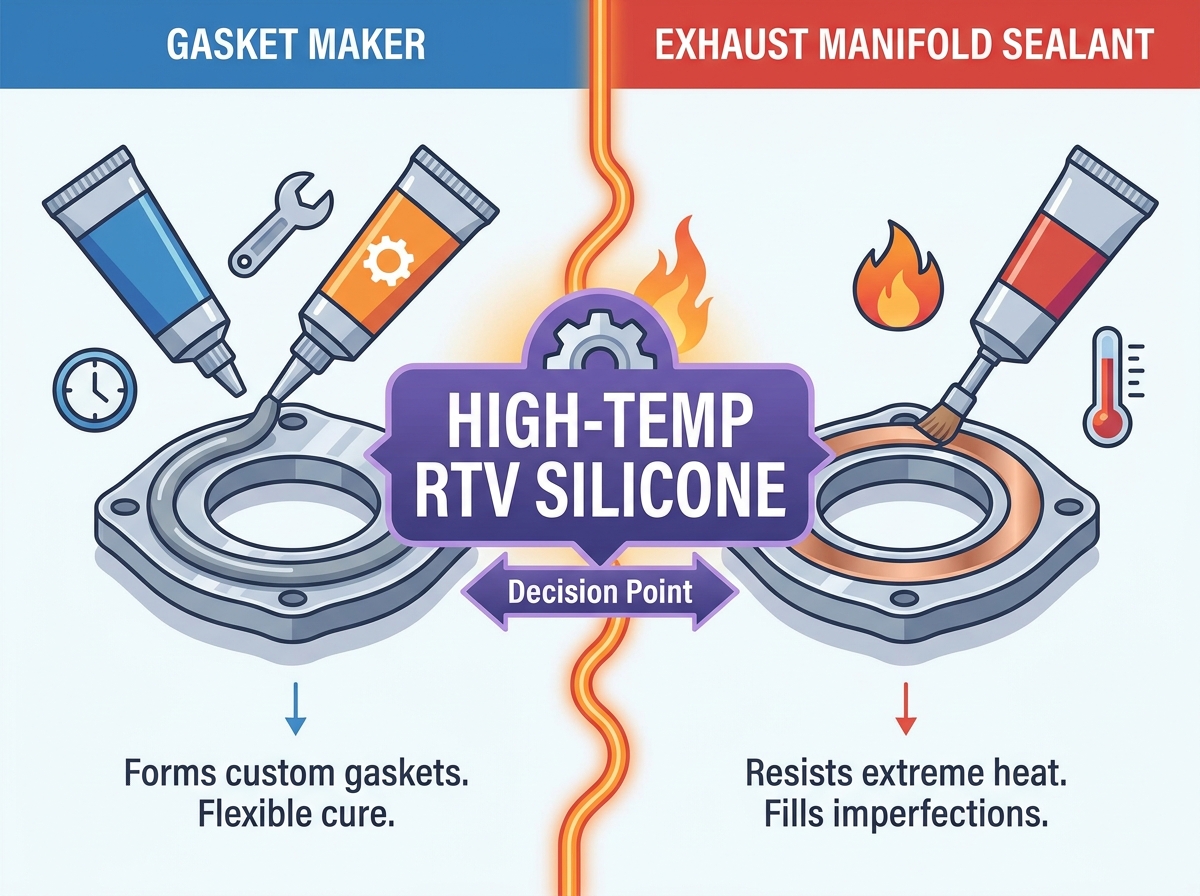
Aerosol copper sealants offer an acceptable supplement for high-heat applications, provided they are used correctly. Copper spray is not a gap-filling gasket maker. Instead, it acts as a micro-filler for very minor surface imperfections. The copper particles suspended in the aerosol can withstand temperatures up to 1,500°F, making them highly resistant to exhaust heat.
When dealing with slightly pitted cast iron surfaces where a dry gasket might struggle to conform perfectly, a light, even coat of copper spray on both sides of the gasket can improve the seal. It also aids in heat transfer across the flange, reducing localized hot spots. However, it should never be used to compensate for a warped manifold. It is a surface enhancer, not a structural repair material.
While unsuitable for the primary manifold-to-cylinder head joint, high-temperature RTV silicone has highly specific, valid applications within the broader exhaust system. It is highly viable for sealing header slip joints, v-band clamps further down the exhaust stream, or sealing the mating surfaces of a catalytic converter flange where temperatures have dropped significantly.
The exhaust gases cool rapidly as they travel away from the combustion chamber. By the time the gases reach the mid-pipe or muffler assemblies, the temperatures often fall well within the 600°F operating range of premium silicone. This differentiates its use on downstream exhaust components from its highly effective use on intake manifolds, water pumps, or differential covers.
Before installing any gasket, you must rigorously evaluate the manifold flange and cylinder head mating surfaces. Cast iron manifolds are notorious for warping after years of heat cycling. If you bolt a warped manifold to a flat cylinder head, no gasket in the world will seal it permanently. You must measure the warpage before reassembly.
Clean the manifold flange completely using a wire brush or plastic scraper.
Place a machinist’s straight edge across the length of the manifold flange.
Attempt to slide feeler gauges between the straight edge and the flange surface, checking between every exhaust port.
Check the flange diagonally in an "X" pattern to check for twisting.
Compare your largest feeler gauge measurement against the manufacturer's maximum allowable warpage specification (typically around 0.003 to 0.005 inches).
If the surface is not flat within the specification, it requires professional machining at a machine shop. Relying on a thick layer of gasket sealant to fill gaps caused by a warped manifold is a guaranteed failure. The sealant will blow out, and you will be pulling the manifold off again.
Legacy manufacturing often relied on precision machining rather than physical gaskets. Older Ford cast-iron blocks, like the legendary Mustang 289 or 302, and classic Jaguar inline-6 engines often featured manifolds installed metal-to-metal directly from the factory. The factory machining tolerances were tight enough to prevent leaks without any intervening material.
However, decades of age, thousands of heat cycles, and inevitable metal fatigue make replicating a true metal-to-metal seal impossible today. The cast iron has shifted and warped permanently. Modern repairs on these classic engines necessitate the transition to aftermarket physical gaskets. Do not attempt to reinstall a vintage manifold bare, even if that is how it came from the factory in 1968.
Marine environments present entirely distinct requirements that alter the sealing strategy. Water-cooled marine exhaust manifolds, such as those found on a Mercruiser 4.3 or Volvo Penta, operate at significantly lower temperatures than automotive manifolds. The constant flow of raw water through the manifold jackets keeps the exterior casting relatively cool to the touch.
This alters the decision matrix entirely. While standard silicone might survive the lower temperatures here, specialized marine gasket cements are heavily preferred. These specific compounds (like Perfect Seal) are designed to prevent galvanic corrosion between dissimilar metals in the water jackets while providing a reliable seal against both exhaust gases and water intrusion. Using automotive techniques on marine engines often leads to water ingestion and catastrophic engine failure.
Using liquid sealants anywhere near the combustion chamber carries significant risks to engine management systems. As silicone cures and is subsequently exposed to heat, it outgasses chemical vapors. Furthermore, excess sealant squeezed into the exhaust port can break off and blow downstream. Both the outgassing vapors and physical sealant blow-by will contaminate upstream Oxygen (O2) sensors and the catalyst bed of the catalytic converter.
Silicone contamination coats the sensing element of the O2 sensor, rendering it blind to the oxygen content in the exhaust stream. This forces the engine computer into a default rich condition, destroying fuel economy and leading to costly sensor replacements and failed emissions tests. If you must use any liquid sealant on an engine, ensure it features a strict "sensor-safe" formulation, though even sensor-safe variants should be kept out of the exhaust ports.
Attempting to fix a warped manifold with a tube of gasket maker is a classic false economy. The conceptual trade-off seems appealing to a DIY mechanic: spend a few dollars on a tube of sealant rather than spending money at a machine shop to have the manifold resurfaced. It feels like a quick win.
However, the high labor cost—whether in shop hours or your own weekend time—of repeating the manifold installation when the sealant inevitably fails makes this a terrible strategy. Removing an exhaust manifold often takes hours of fighting rusted bolts. Doing it twice because you tried to save money on machining is a painful lesson. Do the job correctly the first time with proper machining and dry physical gaskets.
A common, desperate DIY mistake is attempting to fix a "blowing" exhaust leak by slathering high-temperature silicone onto the exterior of a mounted manifold. You will see this on forums: someone tries to push paste into the gap between the head and the manifold while it is still bolted to the engine. This never works.
Internal exhaust backpressure is immense. Combined with the thermal expansion of the metals, the exhaust gases will instantly shear and blow out any external silicone patch applied without disassembly. The sealant has no mechanical clamping force holding it in place. The only way to fix an exhaust leak is to remove the manifold, address the mating surfaces, and install a proper gasket under torque.
Applying a thick layer of liquid sealant can cause severe mechanical issues during reassembly. If excess sealant is pushed into blind threaded holes in the cylinder head, it can create hydraulic lock. As you thread the bolt in, the incompressible liquid prevents the bolt from tightening fully, leading to a loose manifold or a cracked aluminum cylinder head.
Furthermore, a thick, uneven bead of silicone can cause uneven clamping force across the manifold flange. As you torque the bolts, the manifold sits on high spots of cured sealant. This uneven stress distribution frequently leads to cracked cast iron manifolds once the engine heats up and the metal attempts to expand against the uneven clamping load.
Surface preparation dictates the success of the entire job. You must remove all old gasket material, carbon buildup, and rust scale without damaging the cylinder head. Aluminum cylinder heads are particularly vulnerable to gouging.
Use plastic scrapers and chemical gasket removers to soften old material.
Never use aggressive abrasive wheels (like Roloc discs) on aluminum heads. They remove metal quickly and create low spots that guarantee a leak.
Use a flat sanding block with 400-grit sandpaper to gently clean the cast iron manifold flange, ensuring you keep the block perfectly flat.
Wipe all surfaces down with brake parts cleaner or acetone to remove any oil residue before installing the dry gasket.
Always evaluate your mounting hardware before reassembly. Exhaust studs and bolts endure extreme heat cycles, causing them to stretch, fatigue, and lose their clamping ability over time. Reusing old, rusted hardware often results in snapped bolts during the torque sequence.
Replace all fatigued exhaust studs and bolts with high-quality OEM or equivalent hardware. Consider the use of anti-seize compounds on the threads carefully. While a high-temperature nickel anti-seize prevents future rusting and galling in aluminum heads, it acts as a heavy lubricant. Lubricated threads require less turning force to achieve the same clamping load. If you use anti-seize, you must reduce your torque wrench settings by approximately 15% to 20% to avoid over-tightening and snapping the new bolts.
Proper clamping force is the final step in ensuring a permanent seal. Never tighten bolts randomly. Follow the standard methodology for torquing manifold bolts to prevent warping the flange during installation.
Install all bolts finger-tight to ensure the gasket is aligned properly.
Begin torquing from the center of the manifold and work your way outward in an alternating, inside-out pattern.
Tighten the bolts in three distinct passes (e.g., 10 ft-lbs, then 20 ft-lbs, then final torque spec) to spread the clamping force evenly.
After installation, perform a post-installation heat cycle. Run the engine until it reaches full operating temperature.
Let the engine cool completely overnight.
Perform a subsequent torque re-check on all accessible bolts, as the heat cycle often causes the gasket to compress and the bolts to loosen slightly.
Physical gaskets installed completely dry remain the definitive, professional solution for exhaust manifold-to-cylinder head mating. Liquid sealants generally fail at these extreme temperatures, offering nothing more than temporary relief before blowing out and forcing you to repeat the job. By understanding the thermal limits of your materials and focusing on surface preparation, you can execute a repair that lasts the lifetime of the vehicle.
Before beginning your manifold installation, execute the following steps:
Inspect your manifold flange with a machinist's straight edge and feeler gauges to ensure it is perfectly flat.
Source a high-quality MLS or graphite gasket designed specifically for your engine application.
Procure brand new mounting hardware, including studs, bolts, and nuts, to ensure accurate clamping force.
Clean all mating surfaces thoroughly using plastic scrapers and chemical removers, avoiding abrasive wheels.
Verify your torque specs and adjust them if you plan to use high-temperature anti-seize on the threads.
A: No. Modern exhaust manifold gaskets, especially MLS and graphite types, are designed to be installed completely dry. Sealants act as a lubricant that can cause the gasket to slip, and they interfere with the gasket's ability to crush and seal properly against the mating surfaces.
A: It is not recommended for a permanent fix at the cylinder head. Exhaust gas temperatures easily exceed the maximum thermal limit of high-temperature RTV silicone, causing the material to burn up, harden, and blow out under exhaust pressure.
A: No. Applying sealant externally over an active blowing leak will fail almost immediately. The internal exhaust backpressure will easily push through the cured silicone. You must remove the manifold, prep the surfaces, and install a proper physical gasket.
A: Some older manufacturers machined the cast iron manifold and engine block so precisely that they sealed metal-to-metal straight from the factory. Over time, heat warping makes this impossible to replicate, requiring an aftermarket gasket for modern repairs.
A: Yes. Copper spray-a-gasket is designed to withstand extreme heat up to 1,500°F. It helps fill microscopic surface imperfections on pitted cast iron without degrading, ashing, or blowing out like silicone-based liquid sealing products do under high temperatures.
A: Yes. Water-cooled marine manifolds operate at much lower temperatures due to raw water flow. While silicone might survive, specialized marine gasket cements are heavily preferred to prevent galvanic corrosion in the water jackets while providing a reliable seal.


