


Views: 0 Author: Site Editor Publish Time: 2026-07-13 Origin: Site


Discovering an exhaust leak usually starts with a sudden, disruptive rumble from under your vehicle. The immediate temptation is to avoid the muffler shop by reaching for a chemical fix. Welding requires specialized equipment, and replacing entire pipe sections demands significant time and effort. A chemical paste or silicone tube seems like the perfect shortcut to restore quiet operation and seal dangerous gases away from the cabin.
However, the operating environment of an exhaust system is brutal. These components endure constant high-frequency vibration, aggressive exposure to corrosive combustion gases, and extreme temperature fluctuations ranging from freezing ambient conditions up to 2000°F. These factors relentlessly test the physical limits of any chemical bond. Expecting a simple paste to perform like a structural weld often leads to disappointment if the application parameters are misunderstood.
This guide objectively evaluates whether an exhaust system sealant can provide a permanent fix. We will examine how cure times and heat cycles dictate repair success across cars and motorcycles, and establish the technical criteria for choosing between a chemical patch and a mechanical replacement.
Permanence is Conditional: No exhaust system sealant is structurally permanent compared to a weld; lifespan depends entirely on the size of the breach, location (manifold vs. tailpipe), and surface preparation.
Material Selection Dictates Heat Tolerance: High-temp RTV silicones max out around 600°F-700°F, while metallic/ceramic pastes (like J-B Weld ExtremeHeat) can withstand up to 1200°F to 2000°F but lack mechanical flexibility.
Cure Time is Non-Negotiable: Prematurely starting the engine or riding before the initial cure (typically 2-4 hours) or full cure (24-48 hours) is the leading cause of sealant blowout.
Preparation is the Primary Failure Point: Applying sealant over rust, carbon deposits, or grease guarantees a rapid failure due to lack of substrate adhesion.
Defining a successful exhaust repair requires looking beyond just noise reduction. A proper fix must completely eliminate toxic gas leaks to protect vehicle occupants from carbon monoxide exposure. It must restore the system's engineered backpressure, which directly impacts engine performance, idle stability, and fuel efficiency. Furthermore, the repair must stop annoying rattles and drone while ensuring the vehicle can pass stringent safety and emissions inspections. Achieving all these outcomes with a chemical compound requires understanding its physical limitations in a harsh mechanical environment.
There is a fundamental difference between the tensile strength of a mechanical weld and the shear or adhesion strength of a chemical paste. Welding fuses two pieces of metal together, creating a continuous structural bond capable of bearing heavy loads. Chemical pastes rely entirely on surface adhesion. They cannot bear structural weight. If a muffler hanger breaks or a pipe is completely severed, a paste cannot hold the heavy metal components together against the force of gravity and road vibration. You cannot bridge a massive structural gap with a tube of paste and expect it to hold up over a bumpy road.
Thermal expansion and contraction further complicate chemical repairs. Exhaust pipes rapidly expand as they heat up during engine operation and contract as they cool down after shutdown. This constant dimensional shifting places immense stress on rigid repair materials. Over time, the inability of a hard paste to flex with the metal leads to micro-cracking, loss of adhesion, and eventual bond failure. A cast-iron manifold expands differently than a thin-walled steel tailpipe, meaning the repair material must match the specific thermal dynamics of the component.
The application environment also plays a massive role in longevity. Passenger car exhaust systems are generally well-supported by rubber isolators that dampen movement. In contrast, motorcycles, dirt bikes, and ATVs operate in high-vibration, high-RPM environments. The aggressive shaking of a motorcycle exhaust will rapidly destroy a brittle chemical patch, demanding a much more flexible or mechanically reinforced repair strategy. A rigid ceramic paste that works perfectly on a stationary generator exhaust might shatter within miles on a dirt bike.
Repair Method | Structural Strength | Vibration Resistance | Ideal Application Scenario |
|---|---|---|---|
MIG/TIG Welding | Maximum (Fuses metal) | Excellent | Severed pipes, broken hangers, large blowouts |
Chemical Paste/Putty | None (Surface adhesion only) | Poor to Moderate | Pinholes, hairline cracks, slip joint sealing |
High-Temp RTV Silicone | None | High | Muffler connections, tailpipe slip joints |
Bandage/Wrap + Paste | Moderate (Bridging support) | Moderate | Medium holes, rusted sections needing reinforcement |
Mechanics often see vehicles roll into the shop with massive globs of putty smeared over completely rusted-out pipe separations. This is a fundamental misunderstanding of what the product is designed to do. The paste is a sealer, not a structural support bracket. If you can wiggle the two pieces of exhaust pipe independently with your hands, no chemical in a tube will keep them together once the engine fires up and the vehicle hits a pothole.
Selecting the right product requires matching the chemical composition to the specific temperature and vibration profile of the leak location. Using the wrong material guarantees a rapid blowout. The exhaust system is not a uniform temperature zone. The manifold bolted to the engine block sees exponentially higher heat than the tailpipe exiting the rear bumper.
These compounds are formulated with iron, steel, or ceramic binders designed to survive extreme environments. They can withstand direct exposure to manifold-level gases, often rated for temperatures between 1200°F and 2000°F. Once cured, they become incredibly rigid, resembling cast iron. They are best utilized on exhaust manifolds, catalytic converter joints, and high-heat zones where structural movement is minimal. Because they cure so hard, they are highly susceptible to cracking if applied to a joint that flexes heavily during acceleration.
Often recognized by their copper or red coloration, high-temperature Room Temperature Vulcanizing (RTV) silicones offer excellent flexibility. They absorb vibration effectively but have a lower thermal ceiling, generally failing if exposed to continuous temperatures above 600°F to 750°F. These are ideal for slip joints, muffler connections, and tailpipe assemblies further away from the engine block. If you apply RTV silicone to an exhaust manifold or directly before a catalytic converter, it will simply turn to ash and blow out the moment you get on the highway.
These water-soluble cements harden into a glass-like state when exposed to heat. While they offer excellent heat resistance, they are highly brittle. They work well for sealing tiny pinholes in stationary applications but are highly prone to cracking and flaking off under heavy vehicle vibration or pipe flex. They are often used in conjunction with fiberglass wraps to create a hardened shell over a larger defect, but on their own, they lack the durability needed for daily driving on rough roads.
Understanding the heat zones of your specific vehicle dictates your purchase. A V8 truck hauling a heavy load will generate significantly higher exhaust gas temperatures than a compact commuter car. Always check the temperature rating on the packaging and measure it against where the leak is located on the exhaust tract.
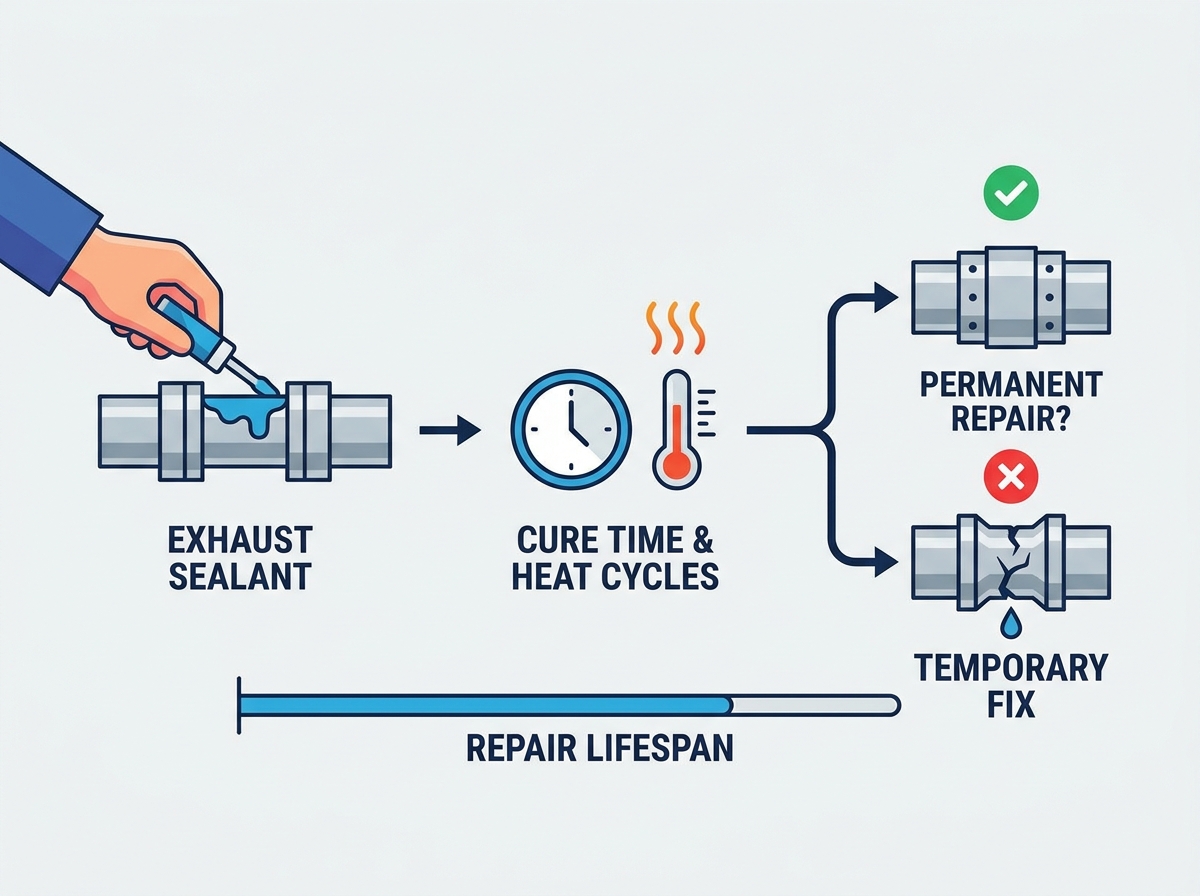
The timeline of chemical hardening directly impacts when a vehicle can safely return to service. Rushing this process is the most common reason chemical repairs fail. You cannot apply the paste, immediately start the engine, and expect the repair to hold. The exhaust gas pressure will simply push the wet material out of the crack.
Understanding the difference between the initial set and a full chemical cure is vital. The initial set occurs when the material becomes tack-free to the touch, often taking anywhere from 20 minutes to 4 hours depending on the formulation. However, the compound has not yet achieved its maximum tensile strength. A full chemical cure, where the material fully cross-links and bonds to the metal, typically requires 24 to 48 hours for standard silicones and air-cure pastes. Driving the vehicle during the initial set phase risks compromising the internal structure of the bond.
Some metallic putties advertise a 20-minute accelerated heat cure. This involves using controlled heat application, such as idling the engine briefly or using a heat gun, to rapidly dry out water-based binders. While effective for specific formulations, applying this method to standard air-cure products or RTV silicones is disastrous. Heating standard silicones prematurely causes the outer layer to skin over rapidly, trapping uncured solvents inside, which then boil and cause the patch to bubble and fail.
Ambient temperature and humidity heavily influence the curing timeline. Cold weather slows down the chemical reaction significantly. High humidity can retard the curing process of moisture-curing silicones or prevent water-based pastes from drying out. In these conditions, extending the wait time well beyond the manufacturer's minimum recommendation is necessary before starting the engine.
Ambient Condition | Impact on Cure Time | Recommended Action |
|---|---|---|
70°F+ and Low Humidity | Optimal curing speed | Follow standard package directions (usually 24 hours) |
Below 50°F | Significantly slowed chemical reaction | Double the recommended cure time; keep vehicle indoors if possible |
High Humidity / Rain | Retards moisture-cure and water-based drying | Allow 48+ hours; protect repair area from direct moisture |
If you are working in a freezing garage in the middle of winter, do not expect a 24-hour cure to be sufficient. The metal itself is cold, preventing the chemical from cross-linking properly. In professional settings, mechanics will often leave the vehicle on the lift over the weekend to ensure a rock-solid cure before handing the keys back to the customer.
Even the highest-quality chemical patch will fail if applied incorrectly. Understanding user errors helps mitigate premature blowouts. The product is only as good as the surface it is applied to.
Aggressive marketing often promotes a repairs-in-seconds fallacy. No chemical compound bonds instantly to dirty exhaust steel. Even the fastest-acting compounds require meticulous surface preparation and adequate physical cross-linking time to survive the intense pressure of exhaust gases. Ignore the marketing hype on the front of the box and read the detailed technical instructions on the back.
Inadequate surface preparation is the leading cause of failure. Chemical compounds will not bond to iron oxide, carbon soot, or road grease. The surface must be aggressively cleaned. If you apply paste over a layer of rust, the paste will bond to the rust, and the rust will flake off the pipe, taking your repair with it.
Elevate and secure the vehicle safely using jack stands or a lift.
Locate the exact source of the leak by looking for black soot marks around joints or cracks.
Use a heavy-duty wire brush or an angle grinder with a wire wheel to strip away all rust and scale around the defect.
Sand the immediate area down to bare, shiny metal using coarse-grit sandpaper.
Spray the area generously with automotive brake cleaner to remove all grease, oil, and residual dust. Allow it to flash off completely.
Apply the compound firmly, pressing it deep into the crack or pinhole to ensure maximum penetration and surface contact.
Attempting to bridge gaps that are too large exceeds the physical limits of the material. Pastes and silicones are engineered for pinholes, hairline cracks, and sealing overlapping joints. They cannot span holes larger than a dime on their own. For larger breaches, the chemical must be used in conjunction with a metal patch or a fiberglass exhaust bandage to provide a structural bridge. The bandage acts like rebar in concrete, giving the paste a skeleton to hold onto.
Pre-mature heat cycling destroys the repair from the inside out. If the engine is started before the material has fully cured, trapped solvents or moisture within the paste will rapidly boil as the pipe heats up. This creates steam pockets that cause blistering, blowouts, and immediate failure of the seal. You will hear a loud pop, followed immediately by the return of the exhaust leak noise.
Deciding between a chemical patch and taking the vehicle to a muffler shop involves weighing several trade-offs regarding longevity, safety, and vehicle compliance.
The cost-to-lifespan ratio heavily favors chemical repairs for minor issues. A tube of paste represents a tiny fraction of the cost of professional welding or replacing an entire catalytic converter or muffler assembly. While a chemical patch may only yield months to a few years of life, it provides immediate relief and delays a major repair bill. Conversely, welding provides a permanent, structural fix but requires a significantly higher upfront investment. If you are nursing an older vehicle through its final years, a chemical patch makes logical sense. If you are restoring a classic car or repairing a nearly new vehicle, mechanical replacement is the correct path.
Inspection and emissions compliance must also be considered. In strict jurisdictions, visible exhaust putty smeared over a catalytic converter or a primary manifold may cause the vehicle to fail an annual safety or emissions inspection. Inspectors often view chemical patches as temporary, unsafe fixes on critical emissions components. For areas subject to strict scrutiny, mechanical replacement is often the only viable long-term strategy. A patch before the oxygen sensor can also alter the sensor readings, causing the engine control unit to adjust the air-fuel mixture incorrectly, leading to poor performance and check engine lights.
Using an exhaust system sealant correctly requires an honest assessment of the damage. If the pipe is structurally sound and simply suffering from a localized pinhole or a loose slip joint, chemical repair is highly effective. If the pipe is rotting from the inside out and crumbling when you touch it with a wire brush, no amount of paste will save it. You must cut out the diseased metal and weld in a new section.
Chemical exhaust repair is a viable, long-term solution for minor leaks, pinholes, and slip-joint sealing when executed with precision. Success depends entirely on matching the right chemical to the heat zone, performing aggressive surface preparation, and respecting the mandatory curing process. It is not a magic fix for structural failure, but it is an invaluable technique for maintaining exhaust integrity without immediate mechanical replacement.
Inspect the leak thoroughly to determine if it is a hairline crack suitable for paste or a structural failure requiring mechanical repair.
Purchase heavy-duty wire brushes and automotive degreaser to ensure the metal surface is completely bare and clean before application.
Plan the repair schedule to allow the vehicle to sit idle for a full 24 to 48 hours to guarantee a complete chemical cure.
Monitor the repaired area after the first few heat cycles to ensure the seal remains intact and no new leaks have formed.
A: You should generally allow the material to cure for a full 24 to 48 hours before driving. This ensures maximum tensile strength. Some specific heat-activated pastes allow for a 20-minute idle cure, but always verify the manufacturer's instructions before starting the engine.
A: Motorcycles and dirt bikes produce extreme vibrations that easily destroy uncured patches. You must allow a full 24 to 48-hour air cure before riding to prevent premature joint blowout and ensure the material has fully bonded to the metal.
A: You can only use a heat gun on specific metallic or ceramic putties designed for heat activation. Using a heat gun on RTV silicones will ruin the repair by causing the outer layer to skin over, trapping wet, uncured material underneath.
A: Standard silicones will melt and fail at these temperatures. You must use specialized metallic or ceramic pastes rated for 1200°F to 2000°F to survive the extreme heat generated by a catalytic converter.
A: It depends heavily on your local jurisdiction. Many strict inspection stations will fail a vehicle if they see visible putty on critical emissions components like manifolds or catalytic converters, viewing it as an improper, temporary modification.
A: No. Chemical pastes and silicones have zero structural strength. They cannot bear weight or hold two separated, heavy metal pipes together against gravity and road vibration. Broken pipes require welding or mechanical clamping.
A: The three most common reasons for immediate failure are poor surface preparation, starting the engine before the product fully cured, or using a rigid, brittle paste on a high-flex, high-vibration joint.


