


Views: 0 Author: Site Editor Publish Time: 2026-07-10 Origin: Site


Exhaust leaks compromise vehicle performance, increase cabin exposure to toxic gases, guarantee failure during emissions testing, and can cause a sudden, costly spike in fuel consumption. The exhaust system is a hostile environment characterized by extreme thermal cycling, constant high-frequency vibration, and corrosive byproducts. Most standard adhesives and sealants will instantly burn off, degrade, or fracture under these conditions. Selecting the correct exhaust system sealant requires matching the chemical composition of the product to the specific temperature zone of the leak and the structural demands of the joint. This guide breaks down the technical evaluation criteria for choosing a reliable sealant and defines the hard limits of chemical exhaust repair, ensuring you apply the right compound to the right component.
Temperature Dictates Chemistry: High-temp RTV silicones (like copper-based sealants) max out around 300°C–370°C and are suited for gaskets and slip joints, while ceramic-based pastes and putties can withstand 1000°C+ for manifold and structural crack repairs.
Flexibility vs. Rigidity Trade-off: Cements and pastes dry rock-hard and are prone to cracking under heavy vibration, whereas silicones remain flexible but cannot bridge large gaps or handle direct combustion temperatures.
Sensor Safety is Mandatory: Any sealant used upstream of the catalytic converter must be explicitly labeled as "sensor-safe" to prevent outgassing from destroying Oxygen (O2) sensors.
Strict Repair Limits: No exhaust system sealant is a permanent structural fix for a completely severed pipe or severe rust-rot; they are designed for pinholes, hairline cracks, and sealing mechanical joints.
Mapping the temperature gradient of an exhaust system is the first step in diagnosing a leak. Exhaust manifolds routinely exceed 600°C as they channel direct combustion gases from the cylinder head. In contrast, tailpipes operate closer to 150°C. Establishing baseline heat requirements prevents the immediate incineration of the applied compound. You cannot apply a low-temperature product to a high-heat zone and expect it to survive the first drive cycle. The thermal load drops significantly as gases travel from the engine block to the rear bumper, meaning the chemical requirements change at every flange and joint.
Engine movement and road shock constantly impact the exhaust assembly. Elastomeric properties are strictly required in slip joints where metal expands and contracts. Rigid adhesion is necessary for static cracks on heavy cast-iron components, but applying a rigid cement to a flexible joint will result in immediate fracturing. The exhaust system hangs on rubber isolators specifically to allow for this movement. When an engine revs under load, it twists on its mounts, sending a shockwave of vibration down the exhaust pipe. A successful repair compound must either absorb this kinetic energy or be applied to a static area where flex is non-existent.
The cured sealant must withstand unburned hydrocarbons, acidic condensation, road salt, and moisture without degrading. Exhaust gases contain corrosive elements that rapidly break down inferior chemical bonds. Assessing the maximum tolerance for bridging physical gaps is equally critical. Chemical compounds are typically limited to bridging gaps of a few millimeters before a physical patch or weld becomes necessary. Water is a natural byproduct of combustion. When a cold engine starts, condensation pools inside the muffler and pipes, mixing with sulfur and other byproducts to create highly corrosive acids. The repair material must be impervious to this internal chemical attack while simultaneously fighting off external threats like magnesium chloride used on winter roads.
Understanding how an unsealed leak upstream of the O2 sensor introduces ambient air is vital for engine management. Unmetered air skews ECU readings, causing a false lean condition. The engine compensates by dumping excess fuel into the cylinders, dramatically increasing fuel consumption and fouling spark plugs. This is why sealing leaks near the manifold or catalytic converter is not just about noise reduction; it is a critical drivability issue. A compromised exhaust stream alters the scavenging effect, reducing the engine's ability to pull fresh air and fuel into the combustion chamber efficiently.
To further illustrate the demands placed on these compounds, consider the pressure dynamics. Exhaust gases are pushed out of the cylinders under immense pressure. A pinhole leak acts as a pressure relief valve, forcing hot, high-velocity gas directly against the repair material. If the sealant lacks sufficient adhesion to the base metal, this pressure will simply blow the patch out from the inside. Mechanical keying—where the sealant physically locks into the rough surface of the metal—is just as important as the chemical bond itself.
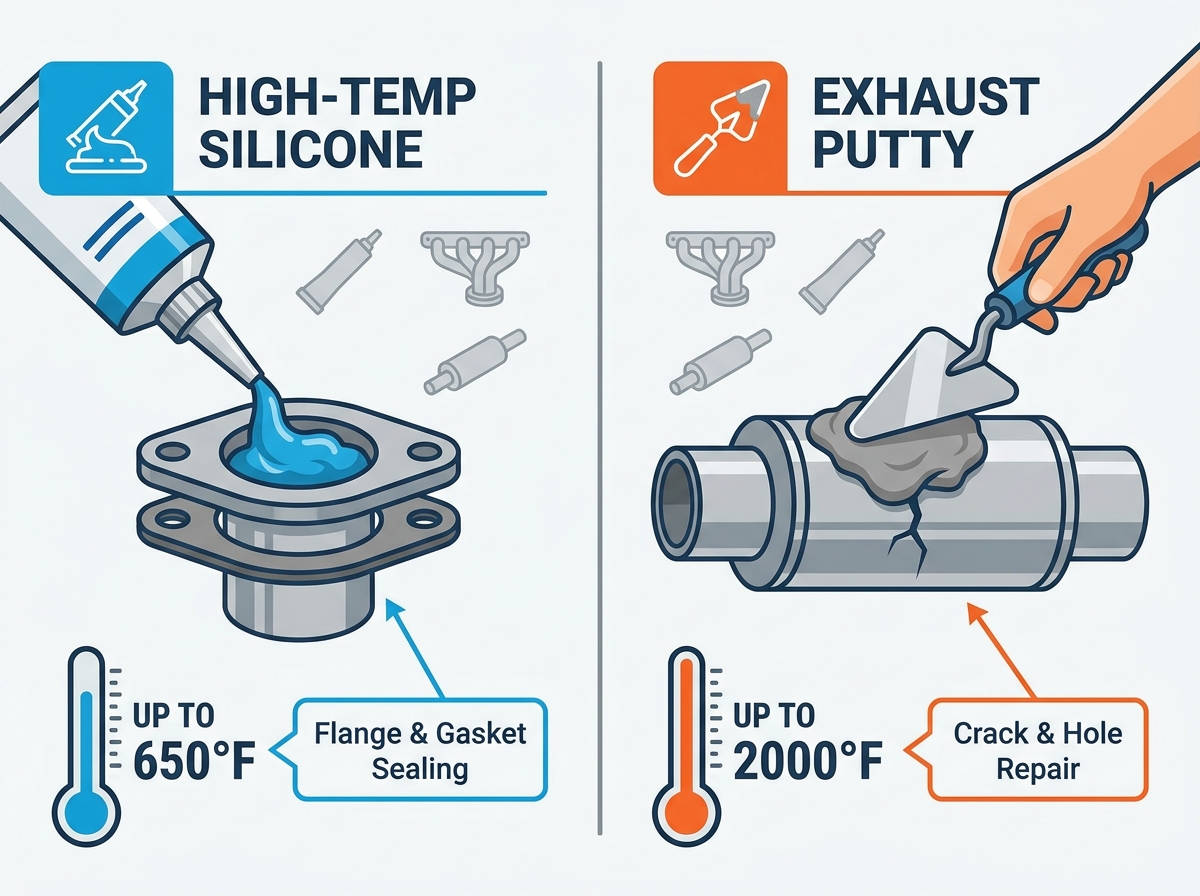
Different chemical formulations serve entirely different repair functions across the exhaust assembly. Using the wrong category guarantees repair failure. You must match the product to the specific physical and thermal demands of the repair zone.
Room Temperature Vulcanizing (RTV) elastomers cure into a flexible rubber upon exposure to atmospheric moisture. These formulations provide proven reliability up to 300°C continuous operation, with intermittent spikes up to 370°C. They are the optimal choice for flange gaskets, slip-fit pipe connections, and sealing clamped joints where vibration is high. However, they cannot survive manifold temperatures and lack the structural rigidity to bridge open holes without a physical backing. High-temp RTV is often copper-colored due to the addition of copper flakes, which improve heat transfer and thermal stability. When applied correctly, it forms a tough, rubbery gasket that moves with the metal as it expands and contracts.
Ceramic, iron, or silicate-based compounds cure via heat into a rigid, metal-like state. They offer extreme temperature resistance, typically rated between 450°C for entry-level metallic pastes and exceeding 1000°C for premium ceramics. Set times can be as fast as 30 minutes before thermal curing begins. These are best used for hairline cracks in cast iron manifolds, pinholes in rigid piping, and filling static gaps. Their primary limitation is zero flexibility once cured; they are highly susceptible to fracturing if applied to a joint that flexes. These pastes often require the engine to be run at idle to bake the moisture out of the compound, transforming it into a hard crystalline structure that can withstand direct flame.
Specialized sealers are designed specifically for wet, water-cooled marine exhaust systems. They have lower peak temperature requirements but offer extreme resistance to saltwater intrusion, galvanic corrosion, and joint expansion. These compounds are strictly utilized for metal-to-metal and metal-to-plastic mating surfaces in inboard and outboard boat exhausts. Marine environments present unique challenges, as the exhaust system is often cooled by raw water drawn from the ocean or lake. The sealant must survive constant submersion, thermal shock from cold water hitting hot metal, and the corrosive effects of salt.
Sealant Category | Maximum Continuous Temperature | Cured Flexibility | Primary Application Zones | Cure Mechanism |
|---|---|---|---|---|
High-Temp RTV Silicone (Copper/Red) | 300°C - 370°C | High (Elastomeric) | Slip joints, flanges, tailpipe clamps | Moisture in the air (RTV) |
Refractory Paste / Ceramic Cement | 1000°C+ | Zero (Rigid/Brittle) | Manifold cracks, rigid pipe pinholes | Thermal baking (Engine heat) |
Marine Specialty Adhesive | 150°C - 200°C | Moderate | Water-cooled marine exhausts, wet joints | Chemical cross-linking |
Epoxy Putty (High Heat) | 250°C - 400°C | Low (Semi-rigid) | Muffler casing repairs, bracket reinforcement | Two-part chemical catalyst |
Beyond these primary categories, some hybrid products attempt to bridge the gap between flexibility and extreme heat resistance, though they often compromise on one or the other. When selecting a product, always prioritize the maximum temperature rating over ease of application. A paste that is difficult to apply but rated for 1000°C will always outperform an easy-to-use silicone that burns away at 400°C when applied to a header pipe.
The manifold sits in direct contact with combustion gases, representing the highest heat zone in the vehicle. RTV silicone will fail immediately here. This environment requires extreme-heat refractory paste or specialized manifold putty. The compound must be sensor-safe to protect downstream O2 sensors from volatile outgassing during the curing process. Cast iron manifolds are notorious for developing hairline cracks due to thermal shock. Repairing these requires a compound that can expand at a similar rate to the cast iron while maintaining its grip under extreme pressure.
The catalytic converter and mid-pipe connections experience moderate to high heat and high vibration, often utilizing slip joints or bolted flanges. High-temp copper RTV silicone is optimal for sealing the microscopic gaps in these mechanical joints. It maintains the necessary elasticity to prevent cracking under chassis flex while handling the thermal load. When installing a new catalytic converter, a thin bead of sensor-safe RTV on the flange ensures a gas-tight seal, preventing the dreaded P0420 check engine light caused by minor exhaust leaks skewing the downstream sensor data.
While operating at lower heat, mufflers and tailpipes endure maximum exposure to internal acidic condensation and external road elements. Both pastes and silicones are viable here. Pastes work well for patching rust pinholes on the muffler body, while silicones excel at sealing clamped joints connecting the tailpipe. Mufflers often rot from the inside out due to trapped moisture. If you catch a pinhole early, a dab of refractory paste can seal it. If you are assembling a new cat-back exhaust system, coating the slip joints with RTV before clamping them down ensures a leak-free installation that can still be disassembled later if necessary.
Motorcycle exhausts generate extremely high-frequency vibration and feature exposed components demanding aesthetic cleanliness. This requires high-temp silicone to seal slip-on sleeves and prevent exhaust gas soot from staining outer pipes. Grey or black silicones are often preferred over bright copper for visual integration, remaining resilient to intense engine harmonics. Sportbikes and cruisers alike use spring-retained slip joints that constantly move. A rigid paste would shatter within miles. High-temp silicone absorbs the vibration, seals the exhaust pulse, and keeps the chrome or carbon fiber clean from black carbon tracking.
Turbocharged vehicles present an even more extreme environment. The exhaust gases driving the turbine can exceed 900°C. Any leak pre-turbo reduces the kinetic energy available to spool the compressor, resulting in massive power loss and turbo lag. Repairs in the pre-turbo up-pipe or manifold require the absolute highest-rated ceramic pastes available, and even then, they are strictly temporary measures until the component can be TIG welded or replaced.
Chemical compounds possess compressive strength but negligible tensile strength. They cannot hold a broken pipe together or support the weight of an exhaust system. Relying on a paste to rejoin a snapped pipe will result in immediate failure as soon as the vehicle hits a bump. The exhaust system is heavy, and the hangers exert pulling forces on the pipes. If a pipe is sheared in half, no amount of paste or silicone will hold it together. You must use a mechanical sleeve clamp or weld the joint.
Pastes and silicones will blow out under exhaust pressure if applied over holes larger than a few millimeters. For larger voids, the chemical compound must be reinforced with fiberglass exhaust wrap or a metal patch to provide a structural substrate. Think of the sealant as the mortar, not the brick. If you have a hole the size of a coin, you must cut a piece of sheet metal, shape it to the pipe, and use the sealant to bond the patch to the exhaust. Applying a thick glob of paste over a large hole will simply result in the exhaust pressure blowing a hole right through the wet compound.
Using non-sensor-safe standard silicones upstream of the catalytic converter releases volatile compounds during the cure cycle. These chemicals permanently coat and ruin O2 sensors, triggering check engine lights and degrading engine performance. The outgassing of acetic acid (which smells like vinegar) from standard RTV is highly destructive to the delicate zirconium dioxide element inside an oxygen sensor. Always verify the packaging explicitly states "sensor safe" before applying any chemical near the engine block.
Framing sealants as highly effective temporary or supplementary solutions is the most accurate approach. Severe degradation, extensive rust-rot, or structural shearing ultimately requires welding or complete component replacement. Rust is a cancer for metal. If you patch one rust hole, the metal next to it is likely paper-thin and will blow out next week. Sealants buy you time to order replacement parts or pass a looming inspection, but they do not reverse metallurgical decay.
Thermal shock is another major failure point. If you apply a ceramic paste, cure it properly, and then immediately drive through a deep puddle, the rapid cooling of the hot exhaust pipe causes the metal to contract violently. The rigid ceramic patch cannot contract at the same speed, causing it to shear off the pipe. Understanding the physical limitations of the materials prevents unrealistic expectations and repeat failures.
Surface preparation dictates the success of the bond. You must remove all rust, carbon deposits, grease, and moisture using wire brushes, sandpaper, and solvent. Sealants will not bond to soot or flaking iron oxide; they require bare, clean metal to achieve mechanical adhesion. Follow these strict steps for application:
Scrub the repair area aggressively with a stiff wire brush to remove all loose rust scales and flaking metal.
Use 80-grit sandpaper to score the surrounding healthy metal. This creates a rough surface profile that allows the sealant to mechanically lock into the pipe.
Wipe the entire area down with a fast-drying solvent like brake parts cleaner or acetone. Do not use oil-based solvents. Allow it to flash off completely.
If using RTV silicone on a slip joint, apply a continuous 3mm bead around the male pipe end, slide the pipes together, and immediately tighten the exhaust clamp.
If using refractory paste on a crack, use a plastic putty knife to force the compound deep into the fissure. Do not just smear it on top; it must penetrate the crack to seal effectively.
Smooth the edges of the paste patch to feather it into the surrounding metal, reducing the chance of it catching on debris or flaking off.
Allow the product to sit at room temperature for the manufacturer's specified set time (usually 1 to 2 hours) before starting the engine.
For ceramic pastes, start the engine and let it idle for 10 to 15 minutes. The gradual heat will bake the paste, driving out moisture and curing it into a solid state. Do not rev the engine during this phase.
Distinguish between a quick 30-minute set time and a full cure. A product may become tack-free quickly, but a 24-hour full chemical and environmental cure is often required before the vehicle is subjected to heavy loads or wet conditions. RTV silicones cure by absorbing moisture from the air. In very dry climates, this process takes longer. Refractory pastes cure via heat. If you apply a paste and leave the car sitting in the driveway for a week without running the engine, the paste has not cured; it has merely dried out and will likely crumble.
When dealing with slip joints, less is often more. Applying excessive amounts of silicone inside a pipe can cause the excess to squeeze out into the exhaust stream. While this usually burns off or blows out the tailpipe, large globs can theoretically break loose and rattle around inside the muffler baffles. Apply just enough to coat the mating surfaces.
The best chemical solution is entirely dependent on the application zone. High-temp RTV silicone is the superior choice for flexible joints and gaskets, while refractory pastes are mandatory for high-heat cracks and pinholes. Evaluate the repair based on the peak operating temperature of the zone, the presence of vibration or flex, and the size of the gap. Using the wrong product guarantees failure, while proper selection and meticulous surface preparation ensure a durable, gas-tight seal.
To execute a successful exhaust repair, follow these immediate next steps:
Inspect the entire exhaust system while the engine is running (and cold) by feeling for escaping air around flanges and joints to pinpoint the exact leak location.
Scrape the metal around the leak with a screwdriver to verify structural integrity; if the metal crumbles, you need a new pipe, not a chemical patch.
Purchase a sensor-safe product strictly rated for the thermal zone you are repairing (paste for manifolds, silicone for tailpipe joints).
Clean the repair zone down to bare, shiny metal using a wire wheel and solvent before applying any compound.
Contact our technical team if you need specialized guidance on selecting compounds for heavy-duty or industrial exhaust applications.
A: When applied correctly to a properly prepared surface within its temperature rating, a high-quality refractory paste or high-temp silicone can last for several years. However, it is generally considered a supplementary repair. Severe rust or heavy vibration will eventually compromise the bond, requiring a permanent welded fix.
A: No. Standard silicone degrades rapidly at temperatures above 150°C. Exhaust components routinely exceed this threshold. You must use high-temperature RTV silicone specifically formulated for automotive exhaust applications, which can withstand continuous temperatures up to 300°C.
A: Yes, if the sealant successfully stops the leak and restores the closed loop of the exhaust system. Eliminating leaks prevents unmetered oxygen from skewing sensor readings and ensures all exhaust gases route properly through the catalytic converter for testing.
A: Most products have a set time of 30 to 60 minutes, meaning they are dry to the touch. However, full curing usually requires 24 hours. Refractory pastes often require a thermal cure, meaning the engine must be idled to heat the exhaust and bake the paste into a hardened state.
A: Absolutely not. Head gaskets endure extreme combustion chamber pressures and require specialized metallic gaskets. Exhaust sealants lack the tensile strength and pressure resistance to seal a cylinder head to an engine block.
A: Yes. A leak upstream of the oxygen sensor allows ambient air into the exhaust stream. The sensor reads this excess oxygen as a lean condition, prompting the engine control unit to inject more fuel, which drastically reduces fuel efficiency.


